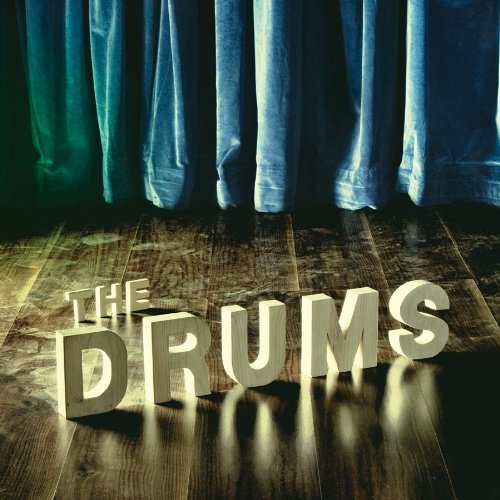
If The Strokes, The Cure, The Smiths, and the Beach Boys all got together had a baby (science is close!), they would name it The Drums. Well, actually, first they’d name it Goat Explosion, and then change their minds to Elkland, before finally settling on The Drums. Despite their apparent indecision in the name department, the band now known as The Drums consciously borrowed elements from several new-wave indie pop giants and beach bums of yore to spawn a band that looks and sounds like a little bit of all of them.
The simple surfer riffs and beachy beats of The Drums’s second album, The Drums, closely follows up the sound introduced in their September 2009 debut, Summertime!. Singles like “Best Friend” and “Let’s Go Surfing” are fun, familiar, and super catchy—perfect staples to any summer playlist. On their website, The Drums explain that they “only write about two feelings: one is the first day of summer when you and all of your friends are standing on the edge of a cliff watching the sun set and being overcome with all of your hopes and dreams at once. The other is when you're walking alone in the rain and realize you will be alone forever."
With tried and true (and all alliterations aside, maybe a little trite) 60s beats, 80s emotion, and earnest, repetitive lyrics, almost every song from The Drums is practically guaranteed to end up stuck in your head. How long it’ll stick around when September rolls around, though, is another question. If The Drums amp up their creativity level and branch out from their cozy cove of well-curated influences, they could potentially be around long enough to inspire the next pretty-boy surfer-pop band.
Recommendations:“Best Friend”, “Let’s Go Surfing”, “Me and the Moon” (not because I especially love it but because it is at least a little bit different sounding.)
The unrequited crush: We’ve all been there. Pining away like Samantha Baker for Jake Ryan, wishing that a) Jake would notice us and sit on our kitchen counter with us, blowing out all 16 of our birthday candles, and that b) we had the perfect maudlin yet hopeful set of tunes to get us through the torment of it all. If any of that sounds familiar to you, then go ahead and turn off the Thompson Twins and switch on Best Coast to mend your breaking heart.
On July 27, California’s Bethany Cosentino and Bobb Bruno, aka Best Coast—who have been tempering teenage heartache for months with perfectly angst-ridden, lo-fi single after single—will finally release their first full-length album, Crazy for You. With a similar sound to the band’s earlier releases, such “Sun Was High (So Was I),” the new album is replete with romantic, hazy, California-sandy tunes, perfect for when you’re, as Cosentino puts it, “sitting all alone at home/ and waiting waiting waiting waiting waiting by the phone.” And, like each single and EP released up to this point (including the questionably trendy Kid Cudi and Rostam Batmanglij of Vampire Weekend mash up), Crazy for You does not disappoint.
Crazy isn’t simply a collection of mindless, boy-crazed sap songs—Cosentino’s creativity and musical knowledge lend a stellar quality to what has the potential to be superficial and repetitive fluff. As demonstrated by the Best Coast blog, Cosentino’s musical influences are ample and varied—the depth of which is reflected by her ability to turn the trite (you can only say “I wish I had a boyfriend” so many ways) into heartrending, universally appealing music. Her wide-ranging inspiration creates subtle, yet hugely different, transitions—evoking everything from 90s Nirvana-esque angst to poppy 60s girl band riffs—that save the music from becoming monotonous and reveal the depth of the band’s well-crafted personality.
With simple but poignant lyrics that could easily have been torn from Molly Ringwald’s diary (“Last night I went out with this guy/he was nice/he was nice and cute/but he wasn’t you”), Cosentino’s perfectly drawling voice gives an uncomplicated and much needed reprieve from whatever ails you. Whether it’s boys or your boring summer job, each three-minute jangle strikes all the right notes. A combination of the Go-Gos, The Beach Boys, and The Primitives, Best Coast supplies 29 minutes of genuine summer-lovin’ bliss that lives up to the expectations created by months of singles, EPs, and cat images (an homage to Cosentino’s feline companion, “Snacks”).
Recommendations:“Boyfriend,” “I Want To,” and “When I’m With You,” but seriously all of them, ideally in a row while biking past his house repeatedly.
Fol Chen really wants to be weird. In 2009, the Los Angeles based indie sextet shrouded the release of their first album in secrecy, concealing the group members’ names and identities and issuing a press release in which they described themselves as sounding like "that mysterious black object that the creepy family is staring at on the cover of Led Zeppelin's Presence album.” I mean, come on. Even after listening to their sophomore album, Part II: The New December—which admittedly does sound like that mysterious object (think enigmatic, wonky, a little bizarre)—I think that giving yourself description is a little on the pretentious side.
And so is Part II: The New December. Fol Chen's official website provides little more than an intentionally vague and elusive video public service announcement featuring actor Brian Cox as insight into their new release (if you can call him reciting the lyrics from “In Ruins” insight: “Walking down the street tonight/Everything’s in ruins/You look good by siren light/Baby whatcha doin?” WTFol Chen?). To validate creating this kind of hype, whatever product you’re pushing had better be freaking rad.
The New December opens with three fairly strong tracks “The Holograms,” “In Ruins,” and “Curtain Call.” “Holograms,” full of odd digital blips and dark drum machine beats, sounds like it should be accompanied by a Tim Burton’s Edward Scissorhands factory line scene (I bet you love that description, don’t you, Fol Chen?). The rhythmic essence introduced here reappears throughout the eclectic rest of the album. “In Ruins,” one of the most cohesive songs on the album, includes both the original core strong tempo as well as some interesting piano and sugary vocals from singer Melissa Thorne. The beat from “Curtain Call” is catchy and reminiscent of the Dirty Projectors or Of Montreal, but with a unique, quirky spin.
The album proceeds to branch out stylistically, including everything form frenetic dance-pop beats to eerie whispering, all the while retaining the same whimsy underpinnings from earlier tracks. Although the sporadic, superficially disjointed nature of the album may come across as off-putting to more conservative listeners, it is hard not to garner an appreciation for the group’s creativity.
Fol Chen wants to be weird, which they accomplished, but it took me a while to care about that. It was hard to get past all the hype and listen to Fol Chen for what they are…but isn’t that the point? They have built up a labyrinthine mythology around their music, which can at times do more to distract than intrigue—but from what I can tell, they are interested in creating a distraction. Though it doesn’t quite live up to the mystique incited by Brian Cox’s dramatic monologue, Fol Chen’s unusual, almost discordant music stands on its own as, at least, a noteworthy experiment and a decent second album.
HEALTH:Disco::Get Color:Disco2. Anyone familiar with pre-2002 SAT analogy jargon can easily decipher that colon-enjambed phrase as “HEALTH’s self-titled debut album HEALTH is to Disco, the remix of said album, as Get Color, the same group’s second album is to Disco 2,the band’s second remix.” Duh.
If you didn’t follow that, or you’re from the Midwest and only ever took the ACTs, here’s the analogy in layman’s terms: Noise-punk band HEALTH made an album in 2007 called HEALTH. They then invited groups like Acid Girls, Narctrax, Nastique, and Thrust Lab to remix the entire album, the product of which they released in 2008 as Disco. Now, HEALTH has taken their 2009 album Get Color and had people like Crystal Castles, Small Black, Javelin, Gold Panda, and Pictureplane remix all of those songs into 2010’s Disco 2.
Still a little convoluted, but that’s the kind of thing one might expect from a group whose two full-length albums (to clarify, that’s HEALTH and Get Color) steer away from conventional musical properties like “rhythm” and “melody” and can more accurately be described simply as “noise.” HEALTH doesn’t even always fit that description; the first 20 seconds of the album are practically blank. While HEALTH drew criticism for being a weak imitation of noise-punk bands like Liars and Boredoms, HEALTH came closer to their goal of a synthesis of digital sound and quality dance beats with Disco and set themselves apart from the crowd.
Again, Get Color, the album on which Disco 2 is based, is more of a musical experiment than a traditional dance/pop album. However, in Get Color, HEALTH stepped up to the big league and out of the shadows of Liars and the like by introducing melody and dancibility, qualities missing in both HEALTH and, for the most part, Disco. Disco 2 predictably and proportionately climbs ever higher, as HEALTH’s strong points—a better original album and a well-practiced and developed handle on intricate synths and dance rhythms—converge.
Disco 2 reaches the balance lacking in previous albums. Tracks like the Cfcf remix of “Before Tigers” and Small Black’s take on “Severin” retain the well-crafted artistic interest of HEALTH’s originals, but transform the songs into addicting, wider-appealing versions. The album opens with “USA Boys”—not a remix but a brand new single from HEALTH that is right at home among the remixes—which sets the tone for the remainder of the CD and begs to be listened to on repeat. The rest of the album features a well-rounded mix of dance beats and ethereal, trance-y songs. While the good tracks are great, a couple of the middle songs, “In Violet (Salem Rmx)” for example, can revert to HEALTH’s older, jam-sesh style, which gets little boring. Fortunately, listening for and figuring out the overlaps in different remix versions is enough to keep you entertained through some of the more repetitive middle minutes.
Where HEALTH’s sound previously leaned towards noise, Disco 2 branches further out than before, creating a bridge between their old sound and more conventional dance music. “USA Boys” stands out as an example of the new path HEALTH seems to be headed down, and if they continue their pattern of full-length album followed by remix, then HEALTH’s next set should score high enough to get them into the college of their choice.
Recommendations: “USA Boys”, “Before Tigers Cfcf Rmx”, “Severin Small Black Rmx”
The Mynabirds What We Lose in the Fire We Gain in the Flood B
The 1960s band The Mynah Birds was a Canadian R&B group who, although they never released an album, was known for featuring a surprisingly large number of big-hitters, including Neil Young, Nick St. Nicholas, and Rick James. Embracing the ‘60s group’s name as well as their adoptive attitude, singer/songwriter Laura Burhenn and producer Richard Swift began the contemporary musical project, The Mynabirds' What We Lose in the Fire We Gain in the Flood.
In the spring of 2009, Burhenn—formerly of Washington D.C.’s defunct indie duo, Georgie James—turned away from her personal losses and a worn-out style to create her own, individual feel. By compiling sounds from gospel hymns and old country harmonies, Burhenn cobbles the echoes of Carole King, Dusty Springfield, and Cat Power, imitating sounds from the past, yet through this amalgamation producing an updated musical perspective.
This all sounds complicated, but ironically what struck me most about What We Lose was the lack of superfluous sound. The best tracks on the album—Wash It Out, for example— are stripped to the bare musical bones and feel very folk-festival simple, an impressive feat given the carefully considered inspiration.
Unfortunately, despite the well-planned and researched approach to the music, The Mynabirds’ final product doesn’t quite live up to its own expectations. On first listen, some of the songs left me skipping around in hopes of a standout sound, which I never quite found. In truth, I would rather listen to the original music of most of Burhenn’s muses than to her take on them.
Like the 1960s Mynah Birds, Burhenn’s Mynabirds compile and present a huge amount of potential that is never fully realized. An intellectually intriguing, understated album, What We Lose in the Fire gives a new, but not necessarily exciting, take on a good sound and showcases what is, unquestionably, a decent amount of talent.
Recommendations: “Let The Record Show,” “Wash It Out,” “Numbers Don’t Lie”
These days, a lot of people think that any guy with a Mac and a mop of straggly hair can rip off his sweaty t-shirt and make good electronic music. If the influx of GarageBand “musicians” has shown us anything, though, it’s that this is far from the case. It is not enough for some dude to lay down a beat and mess around with a synthesizer; electronica/dance music has to fulfill the same standards of integrity to which other genres are held in order to count, I think, as worthwhile music. ReRunner’s On Three… meets, if not exceeds, these expectations.
In only four tracks, ReRunner creates catchy, intricate melodies conducive to both dancing and hipster head bopping. With sound clips from Michael Anderson’s 1976 sci-fi movie Logan’s Run, a subtly‘80s dance mix vibe, and a variety of cyclical electronic beats, all four songs meld together into a cohesive and techno-party worthy album. ReRunner’s success lies in that they don’t simply mash these features up into an incomprehensible jumble, but instead organize them into well-conceived, comprehensive songs. None of the tracks are exceptionally memorable in their own right, but together they demonstrate that ReRunner brings its own flavor to the electronica scene and shows promise for quality jams to come.
Recommendations: “Last Day” (the one with Michael York breathlessly repeating, “Look…I’m a runner!”)
-- Emma Forster "Regional Rotations," Wednesdays 2-4 pm on WGTB
I am usually game for a little dance-party-inducing electropop music. There is a special place in my heart for the likes of Justice, La Roux, and David Guetta. That being said, the next time I get the urge to let go of my dignity and dance like Kylie Minogue, I will not be reaching for anything by Van Go Lion.
While the opening 30 seconds of “Convenience Stores and Parking Lots” seems to foretell the bubblegum pop-quality tunes that I can see myself guilty pleasure grooving to, as soon as vocalist Amy Paige opens her mouth I lose all interest. She continues to ruin a few of keyboardist Josh Loerzel’s potentially decent beats with her whiny, trite-sounding singing. Too slow to really get any kind of dance party going and too superficial to incite enjoyment on a more artistic level, Van Go Lion’s demo serves up six tracks worth of disappointment.
English rock trio Archie Bronson Outfit’s third album,Coconut, drastically breaks from the sound that the group establishes in their 2006 release DerdangDerdang. With an onslaught of reverberating, psychedelic sounding songs, Coconutoffers up, if nothing else, a fresh new sound. Syncopated cymbal bashing and psych guitar twanging amalgamate to create an impressive punk-dance vibe and generate some serious synthesizer-backed momentum in the first half of the album.
However, the innovative and overwhelming chaos that resounds through songs like “Shark’s Tooth” and “Magnetic Warrior” becomes overwhelmingly claustrophobic in the latter half of the album. Beginning with “You Have A Right To A Mountain Life / One Up On Yourself,”Coconut goes off on a bewildering tangent that nearly countermands the quality of the earlier tracks. The final song, “Run Gospel Singer” manages to round out the album with a little bit of the initial magic, but even its uncommon garage-psych-gospel quality fails to salvage the plodding dregs of the mediocre midsection.
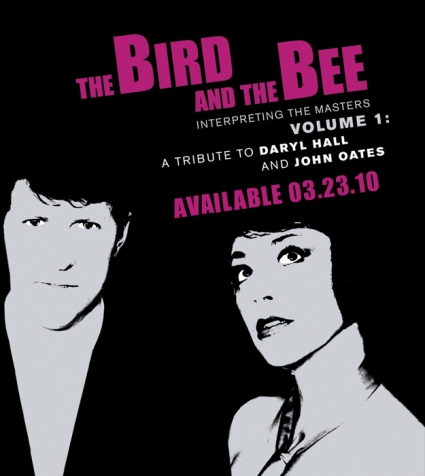
Interpreting the Masters Volume 1: A Tribute to Daryl Hall and John Oates
A
The Bird and the Bee is a band after my own heart—anyone who endeavors to cover the venerable 80s pop icons Daryl Hall and John Oates deserves some serious laud. I was a little worried that without the novelty ofmullets and Blue Magnum-worthy iconography to accompany the tunes, Hall and Oates’s music would lose some of its magic. Fortunately, however, The Bird and the Bee’s rendition not only does justice to the “Masters,”but cements Hall and Oates’s (sometimes questioned) merit as musicians.
Inara George and Greg Kurstin(Bird and Bee, respectively), translate hits like “Private Eyes” and “Kiss On My List” into their own indie/synth style, addinga level of depth and sophistication to the originals. A couple of the weaker songs, “One On One” and “Sarah Smiles,” for example, don’t work quite as well, but that more reflects the integrity of Hall and Oates’s originalsongs than a failure on the part of George and Kurstin. The best tracks on the album introduce a fresh sound that sometimes even surpasses the originals.
The combination of George’s sweetlyrical touch and Kurstin’s reworking of the original, very recognizable, material into more contemporary beats creates unique, modern versions of some truly classic songs. Thanks Bird and Bee, I can definitely go for that.
Especially recommended tracks: “I Can’t Go For That,” “Maneater”
I think it was a bit presumptuous of Laurent Bourque to title his debut album What We Talk About. The only reason I can conceiveof as to why anyone would be talking about it is if they were comparing him to other artists who have accomplished what Bourque only attempts. Granted, Bourque is a talented musician with amellifluous voice, a reasonable amount of talent, and the album isn’t unlistenable, but his trite love-song lyrics leave more than a little to be desired. He has chosen a genre, tone, and set of cliché lyrics that have been proven to work for other artists, but all together the compilation sounds like a knockoff of these more impressive musicians. Think John Mayer but not as catchy; Jason Mraz but with a less interesting voice. One non-descript song titlesays it all: “Always Alright.” I am not all that surprised that I haven’t heard anyone talking aboutWhat We Talk About.It’s “alright,” but if I want to listen to acoustic guitar, angsty vocals, and a significant amount of “oohs” and “yeahs,”I have a wide array of more inspiring options from which to choose.
Deal breakers: snooze fest, copy-cat, and vague, uninspiring lyrics
Redeeming qualities: cool album cover art, Canadian, and (thank God) only 36 minutes long
-- Emma Forster
Host, "Regional Rotations," Wednesdays 2-4 pm on WGTB
Rewolf, the acoustic adaptations of previously released songs from the band led by Japanese vocalist Yuki Chikudate and guitarist James Hanna, is an enjoyable addition to the group’s earlier, more substantial material. While the structure of the reworked songs remains essentially identical to those on which they are modeled, the instruments and tone have changed completely to create a softer, more ethereal lineup. Accompanied by an ensemble reduced to xylophone and acoustic guitar, the delicate melodies feature airy tinkling and angelic English and Japanese vocals. The fluidity that helps create a cohesive album also renders the distinction between songs a little vague. Rewolf’s consistently beautiful—but lightweight and bordering on repetitive—quality lends itself well to easy listening or napping and amounts to a good album of acoustic renditions.
-- Emma Forster Host, "Regional Rotations," 2-4 pm Wednesdays on WGTB